Castel Sant'Angelo History – Hadrian's Mausoleum to Modern Museum
Detailed timeline of Castel Sant'Angelo: imperial mausoleum origins, fortress adaptations, papal refuge use, prison era, and modern museum transformation.
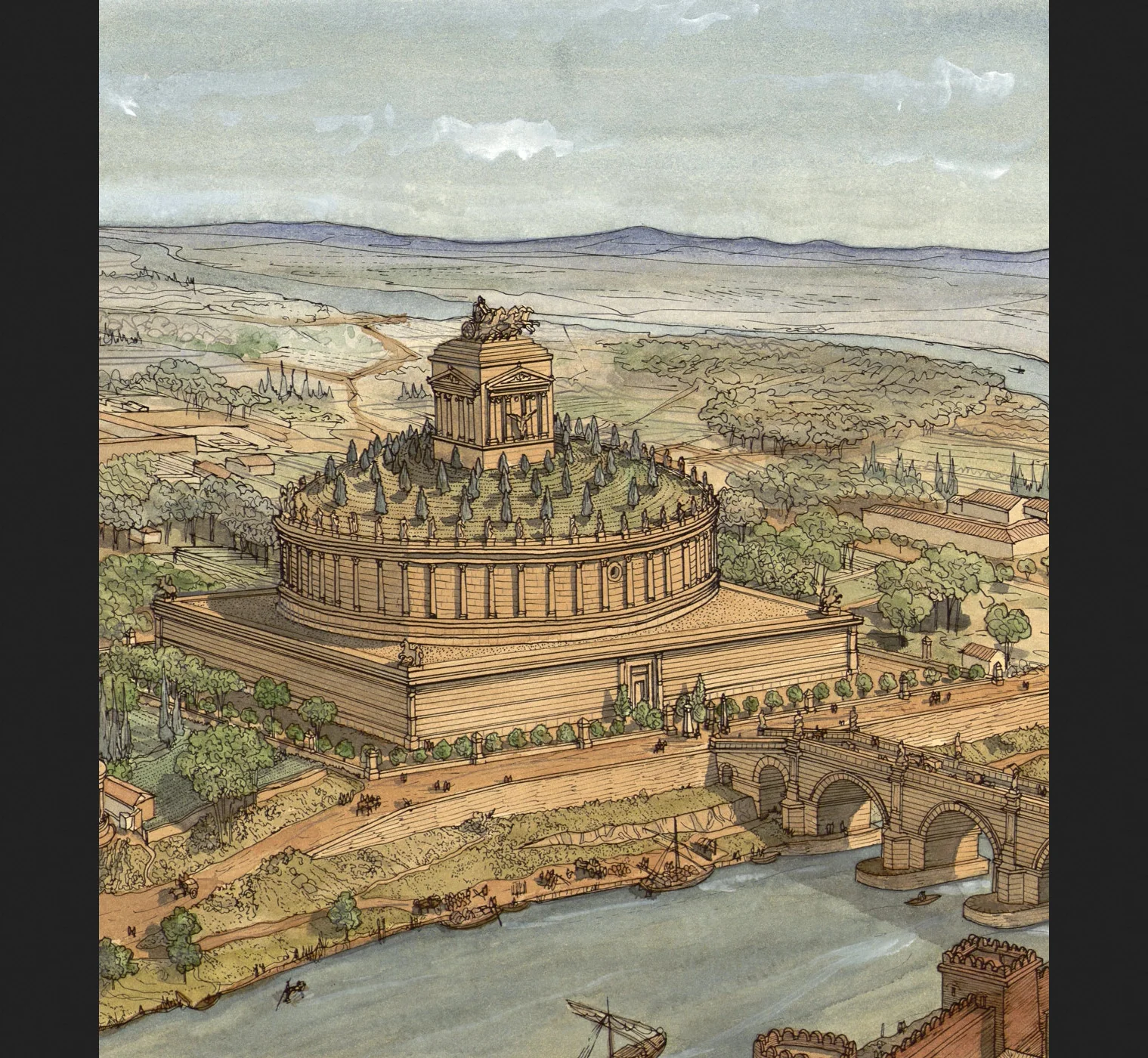
Castel Sant'Angelo compresses 1900 years of adaptive reuse—each layer responding to threats, theology, politics, or urban evolution.
Timeline Overview
| Date | Phase / Event | Significance |
|---|---|---|
| 123–139 CE | Commission & completion under Hadrian / Antoninus Pius | Imperial dynastic mausoleum on Tiber bank |
| 3rd c. | Partial spoliations & urban integration | Rome's shifting funerary landscape |
| 271–275 CE | Aurelian Walls constructed | Mausoleum proximity prompts future defensive logic |
| Late 4th–5th c. | Decline of imperial burials here | Christianization of Rome; memory repurposing |
| 6th–9th c. | Use as stronghold during Gothic wars | Strategic river pivot controlling bridge crossing |
| 10th c. | Crescent of fortification additions | Towering battlements begin formal fortress identity |
| 1277 | Papal acquisition; fortified link envisioned to Vatican | Seeds for Passetto protective corridor |
| 1492–1503 (Alexander VI) | Major military upgrades; artillery embrasures | Gunpowder age adaptation |
| 1527 | Sack of Rome: Clement VII escapes via Passetto | Fortress legitimizes papal survival narrative |
| 16th–17th c. | Papal apartments frescoed; prison use established | Dual role: splendor + control |
| 1800–1814 | Napoleonic administration | Military depot; symbolic reclamation struggles |
| 1870 | Italian unification; new national context | From papal stronghold to Italian heritage asset |
| 1901–1933 | Restoration campaigns; museum structuring | Conservation science emerges |
| 20th–21st c. | Ongoing musealization & public programming | Balance between tourism and integrity |
Imperial Conception
The cylindrical form mirrored earlier dynastic mausolea (Augustus) but embraced monumental river frontage for processional display. Decorative bronze and statuary apex long lost (possibly quadriga or Hadrian statue).
Militarization Drivers
River crossing control + proximity to Vatican and city walls made the structure prime for artillery era retrofitting (angled bastions, merlons, casemates). Mass of drum offered anchor for added defensive rings.
Papal Refuge Narrative
The Passetto di Borgo—a raised corridor—converted geography into security protocol. The 1527 Sack dramatized its necessity: Clement VII's flight is central to fortress mythology.
Prison Layer
Cells housed notable figures: political prisoners, artists entangled in papal jurisprudence. Confinement spaces reveal Rome's intertwining of culture and control.
Modern Museum Era
Shift from punitive / defensive to interpretive: curated routes show transformation rather than single-era freeze, with panels explaining excavated burial chambers vs later cannon placements.
Unresolved Research Angles
- Exact decorative schema of rooftop sculptural program still debated.
- Sequencing of specific papal apartment fresco cycles vis-à-vis military modifications.
Bottom Line
Castel Sant'Angelo survives not by remaining static but by absorbing new identities—mausoleum, bulwark, papal lifeboat, prison, cultural museum—all stratified in stone.
About the Author

Telmo Rolando
I wrote this guide to help you explore Castel Sant’Angelo with confidence — clear tickets, smart routes and the highlights you shouldn’t miss.
Tags
Comments (0)
Loading comments...